Drawing-Based Processing and Sample Customization Empowers Luoyang Yaojia Trading Co., Ltd. to Support Global R&D Projects
From Customer Drawing to a Casting Sample
For many overseas automotive and machinery companies, a new casting project starts with a drawing rather than a purchase order.
The engineering team may have already completed most of the component design, but there is still an important question to answer: can the proposed part be cast reliably and then machined to the required dimensions?
This is where Drawing-Based Processing and Sample Customization becomes useful. Yaojia Trading works from customer drawings and technical requirements, reviews the proposed structure from a casting perspective, and discusses possible changes before a trial part is made.
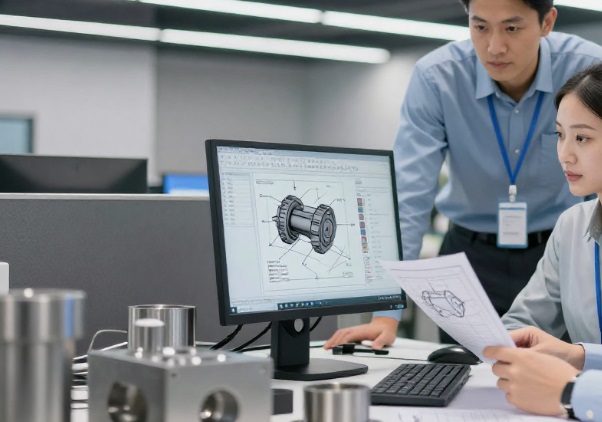
The Drawing Is Only the Starting Point
A component that looks straightforward on a CAD screen may present different challenges once it enters the casting process. Wall thickness, corners, draft angles, machining allowance, material flow, and other details can all affect the final result.
Yaojia accepts technical drawings in different formats and reviews the key manufacturing details before production begins. Where a design feature could make casting more difficult, the engineering team can raise the issue with the customer and discuss a practical alternative.
This early exchange can save time later. It is much easier to discuss a structural change while the project is still at the sample stage than after production tooling and a large order have been committed.
Some Projects Need More Than One Sample
New automotive components do not always pass validation on the first attempt.
A sample may reveal a dimensional issue, a casting defect, or a feature that needs to be adjusted for assembly. Several rounds of testing and modification may therefore be necessary before the customer is ready to approve the final design.
For these projects, Yaojia assigns project personnel to follow the sample from drawing review through production and inspection. Customers receive progress updates during the trial process, together with inspection information for the completed samples.
For overseas engineering teams working across different time zones, keeping these details in writing makes technical communication considerably easier.
Making the Move to Mass Production Easier
Getting a sample approved is an important milestone, but it is not the end of the development process.
The next question is whether the approved design can be produced consistently in larger quantities.
Yaojia connects Drawing-Based Processing and Sample Customization with Precision Casting Mass Production, allowing the production requirements identified during sampling to be carried forward into the next stage.
This reduces the need to start the technical discussion all over again when the project moves from prototype quantities to regular orders. Production planning can also be prepared in advance when a customer expects a significant increase in volume after sample approval.
Samples Should Represent the Real Production Process
A trial casting is most useful when it gives the customer a realistic indication of what the production part will be like.
Through its Complete Casting Industry Chain Services, Yaojia can coordinate mold development, casting, heat treatment, machining, and inspection as part of the same project. Sample parts are therefore not treated simply as quick demonstration pieces.
The production conditions, material requirements, and inspection criteria can be aligned with those planned for regular orders. This gives the customer more meaningful information when evaluating dimensions, mechanical performance, assembly fit, and other requirements.
Quality Checks Apply to Samples Too
There is little value in approving a sample that has been inspected less carefully than the parts that will eventually be supplied in volume.
Yaojia applies Full-Process Quality Control and Assurance to sample development as well as regular production. Depending on the component and customer requirements, sample inspection may cover dimensions, material composition, mechanical properties, and other specified characteristics.
Inspection results are recorded so that engineering teams have concrete data to work with during the validation stage.
If a sample does not meet the drawing requirements, the issue can be discussed and corrected before the project proceeds to larger production quantities.
Experience Helps When the Design Is Not Straightforward
Not every customer drawing follows a standard casting design.
Some projects involve unusual geometries, difficult wall sections, special alloys, or other features that require more engineering attention. In these cases, practical casting experience can be useful when deciding how a component should be produced.
Yaojia's founder, Mr. Xi Xianmin, has 25 years of experience in the casting industry. The company's technical team draws on this background when reviewing difficult sample projects and discussing possible process adjustments.
The objective is not to redesign the customer's component unnecessarily. It is to identify manufacturing concerns early and find changes that still meet the intended function of the part.
Working With Overseas Engineering Teams
Prototype development can be challenging when the supplier and customer are thousands of kilometers apart.
Yaojia works with international customers in markets including South Korea, Japan, the United States, Australia, and Germany. Drawing comments, technical questions, inspection results, and sample feedback can be exchanged online, allowing the project to continue without requiring the customer to travel to China for every development step.
English-language drawing feedback and sample inspection reports also give overseas engineering teams a written record of the technical discussion.
For a new supplier relationship, this kind of documentation can be just as important as the sample itself.
Keeping Prototype Costs Under Control
R&D budgets are often limited, particularly during the early stages of a new component program.
One advantage of dealing with manufacturing issues during sample development is that potential problems can be identified before they become production-scale problems. A change made during prototyping is generally easier to manage than a tooling or process change after mass production has started.
Yaojia provides quotations for sample projects based on the required process, material, tooling, and inspection work. Clear cost information allows customers to evaluate the development stage before committing to larger production quantities.
Simulation and Process Development
The company's 16-member R&D team also works on casting process development, including the use of simulation tools to study potential defects before tooling is manufactured.
Simulation cannot replace physical samples, but it can provide another reference when engineers are considering material flow, shrinkage, or other casting-related risks. Using this information during the development stage can help the team decide which areas deserve closer attention during the first trial.
The physical sample then provides the final check against the customer's actual requirements.
Visit the Production Base
For customers who prefer to evaluate a supplier in person, Yaojia welcomes factory visits at its production base at No. 1 Xianglu Mountain Future Avenue, Yiyang County, Luoyang City, Henan Province.
An on-site visit gives customers the opportunity to see the production and inspection processes directly, discuss technical requirements with the engineering team, and understand how Complete Casting Industry Chain Services are organized.
For a new casting project, that face-to-face discussion can be particularly useful before moving from drawings and samples into regular production.
From the first drawing review to sample inspection and eventual Precision Casting Mass Production, the aim is to keep the technical information connected throughout the project. For overseas buyers, that continuity can make the transition from product development to repeat purchasing considerably easier.